What Our Lighthouse Knows: A Love Letter to the Beacon Next Door
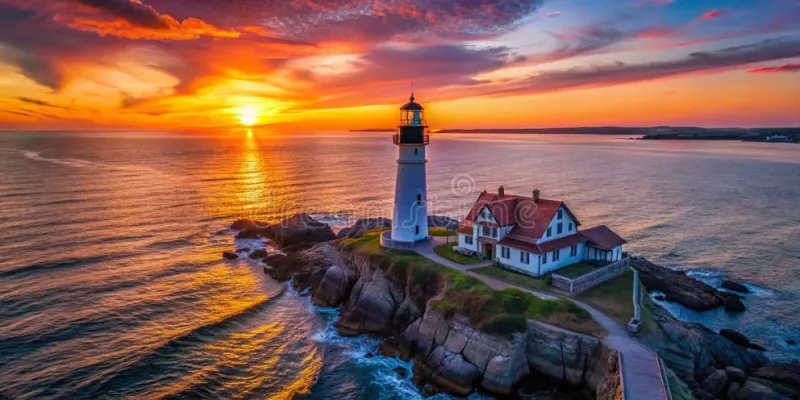
Photo: classic New England lighthouse at sunset with harbor and rocky coast, via thumbs.dreamstime.com
There's a moment that happens on almost every porch evening here at The Breezy Inn. The sky starts doing its thing — peach, then plum, then that impossible in-between color that no paint store has ever managed to bottle — and right on schedule, a beam sweeps across the harbor. Guests go quiet. Mugs pause halfway to lips. Somebody eventually whispers, "Is that...?"
Yes. That's ours.
Every Coastal Town Is Defined by Its Light
Spend enough time rambling up and down the American seaboard and you'll notice a pattern: the towns worth returning to almost always have a lighthouse, and the lighthouse almost always tells you the truth about the town.
A gleaming, immaculately restored light with a gift shop the size of an airplane hangar? You're probably in a town that knows exactly what it is and isn't shy about it. A squat, weather-beaten tower at the end of a gravel road, paint peeling in honest strips? That's a place that has never once hurried for anybody. And a modest white beacon on a rocky point, quietly doing its job for 150-odd years while the town grew up around it? Well. That one sounds a lot like home.
Lighthouses were America's first tourism infrastructure, in a way — the original welcome signs. Before there were interstate exits or highway billboards, there was a keeper trimming a wick and a beam saying, safe harbor this way. Towns were literally built around that promise. It's no accident that the communities that grew up in a lighthouse's shadow tend to share its personality: steady, unpretentious, oriented toward helping people find their way in.
What Ours Says About Us
Our light isn't the tallest on the coast, and we'd never claim it's the most photographed (though come golden hour, it gives the famous ones a real run for their money). What it is, unfailingly, is present. It has guided fishing fleets through fog, watched schooners become speedboats become kayaks, and outlasted every storm the Atlantic has thrown at it without complaint.
That's the local character in a nutshell. Nobody here is trying to be the next big thing. We're trying to be the same good thing, season after season. The harbor still works. The chowder recipe hasn't changed. The keeper's quarters, now a small museum run by the historical society, still opens its door on summer weekends and hands you a cup of coffee like you're an old friend who's slightly late.
How to Spend a Day in the Beacon's Glow
Here's the thing about lighthouse towns: the light is the anchor, but the day you build around it is the real souvenir. This is our favorite slow-travel itinerary, and every bit of it happens within a short walk or drive of our front porch.
Morning: Harbor Walk First, Coffee Second. Start where the light does its best work — the harbor path that curves from the marina around to the point. It's an easy, mostly flat stroll of about forty-five minutes if you don't dawdle, and roughly three hours if you do it right. Expect lobster boats, herons, and at least one local who will tell you the story of the Great Storm of whenever-it-was.
Midday: Climb the Keeper's Stairs. The keeper's quarters open for tours Thursday through Sunday in season. The volunteer docents are a delight — ask about the last civilian keeper, a woman who reportedly kept a garden on the seaward side and refused, on principle, to plant anything that couldn't survive salt. The climb to the lantern room is 78 steps. Your legs will remember it; so will the view.
Afternoon: Do Absolutely Nothing, Properly. This is the step most itineraries skip, and it's the most important one. Find a bench. Watch the tide do its slow, patient work. Read the historical marker, then stop reading things. This is the lighthouse's real lesson: some of the most valuable work is simply staying put and being steady.
Evening: The Golden Hour Pilgrimage. Head back to the point about forty-five minutes before sunset. Bring a sweater (you'll thank us), a camera you actually enjoy using, and zero expectations of getting the "perfect" shot — because the perfect shot is the one with your favorite people in it, wind-blown and grinning. When the beam kicks on and sweeps the water for the first time that evening, you'll understand why generations of travelers built entire trips around this exact moment.
The Takeaway
A lighthouse can't tell you where you're going. It tells you where you are — and that you're not lost. That's what ours has whispered across the harbor for a century and a half, and it's the same promise we make to every guest who signs our guest book: you've arrived, you're welcome, stay awhile.
When you book your stay with us, mention you're coming for the light. We'll point you to the porch rockers with the best view of the beam — and we'll have the coffee on before your first harbor walk.
The Breezy Inn is a short stroll from the harbor path and a five-minute drive from the lighthouse point. Sunset reservations for our front-row rockers not required, but early arrival strongly encouraged.